Help shape practical approaches to regulation and supervision for a changing financial system

Join the Alliance for Innovative Regulation (AIR) for a two day, in-person Policy TechSprint bringing together regulators, financial institutions, technology firms, consumer advocates, policy experts and other financial ecosystem leaders.

Participants will work in multidisciplinary teams to develop and test practical proofs of concept. These may include policy frameworks, supervisory approaches, digital tools, data models and implementation roadmaps.

📅 October 7–8, 2026
📍 Washington, D.C.
💻 Virtual participant orientation and bootcamp: September 30, 2026
🚨 Application deadline: September 14, 2026

Why Participate?

The Policy TechSprint offers participants an opportunity to:

Selected concepts may be considered for further research, testing or development after the Policy TechSprint.

About the Policy TechSprint

The Reframing Financial Regulation Policy TechSprint is designed to move from discussion to practical exploration.

During the TechSprint, participants will work in multidisciplinary teams to examine defined challenges, develop solution concepts, test assumptions and refine their proposals with support from facilitators and subject-matter experts.

The event will conclude with a Demo Day session, when teams will present their proposed solutions to in-person observers, senior stakeholders, judges and experts.

Teams may develop:

Policy or supervisory frameworks

Digital tools, dashboards or workflows

Data models or activity-risk taxonomies

Simulation or sandbox concepts

Standards
or
certification models

Legal, regulatory or implementation roadmaps

AI-assisted examiner or decision-support tools

The objective is not to reach consensus on a single regulatory model. It is to generate credible, practical concepts that can inform continued discussion, research, testing and potential implementation.

Initial Challenge Areas

Many regulatory frameworks rely on asset size, charter, institutional form and structural restrictions as proxies for risk. These approaches offer clarity and administrative simplicity, but they may also create regulatory cliffs, encourage arbitrage, distort institutional behavior and result in different treatment for similar activities based on who performs them.

Modern data, analytics and supervisory technology may make it possible to identify and monitor risk more directly. This challenge will explore how regulatory frameworks could evolve and how examiners could gain practical tools that support more consistent, proportionate and risk-focused supervision.

How might we:

Move from static thresholds and structural categories toward more risk- and activity-based regulation and supervision, while equipping examiners with data and AI-assisted tools to assess probability and severity, prioritize material risks and apply the framework consistently?

Illustrative Areas Teams May Explore:

  • Supplementing asset-size thresholds with indicators such as activity, transaction volume, complexity, interconnectedness, consumer reach and risk profile
  • Mapping similar activities and risks across banks, fintech companies, platforms and other market participants
  • Examining how banking-commerce asymmetries, bank-fintech partnerships and embedded-finance structures affect the regulatory perimeter
  • Helping examiners assess probability, severity and materiality, as well as the appropriate level of supervisory escalation
  • Using AI-assisted triage to help distinguish material financial risks from less significant process or documentation issues

These examples illustrate the scope of the challenge but are not exhaustive or prescriptive.

Rapidly evolving technologies, products and business models are challenging regulatory frameworks designed for more stable market structures and slower cycles of change. Regulators need mechanisms that help them learn and adapt as markets evolve, while providing sufficient certainty for firms, treating functionally similar activities consistently and protecting consumers and financial stability.

Agentic AI, embedded finance, digital assets and 24/7 payments offer practical use cases for examining how regulation can become more adaptive. Consumer protection will be a central focus, particularly when automated or platform-based financial services create unclear accountability, reduced consumer awareness or gaps in liability and recourse.

How might we:

Enable regulators to continually learn and adapt rules, guidance and supervisory approaches as technologies, products and risks evolve, while preserving regulatory certainty, treating similar activities consistently and protecting consumers and financial stability?

Illustrative Areas Teams May Explore:

  • Determining which regulatory expectations should remain stable and which should be able to evolve more quickly
  • Regulating activities according to their functions, intended outcomes and risks rather than only their technical structure, label or delivery channel
  • Creating mechanisms that help regulators identify emerging risks and update guidance, standards or supervisory approaches before significant harm occurs
  • Clarifying accountability, liability, disclosure and recourse when AI agents, platforms, financial institutions, issuers or third-party providers contribute to consumer harm
  • Using sandboxes, simulations, standards, certification and public-private engagement to support responsible experimentation and regulatory learning

These examples illustrate the scope of the challenge but are not exhaustive or prescriptive.

Who Should Apply?

The Policy TechSprint is designed for people who can contribute a range of regulatory, industry, technical, operational and consumer perspectives to the challenge areas. We welcome applications from:

• Federal and state regulators & policymakers
• Banks, fintech companies & other financial institutions
• Technology & infrastructure providers
• Consumer advocates & nonprofit organizations
• Trade associations

• Legal, compliance, risk & supervisory professionals
• Government affairs & public policy professionals
• Academics, researchers and consultants
• Product, engineering, data, analytics, design & communications professionals

Applicants do not need expertise in every aspect of financial regulation or technology. AIR will build multidisciplinary teams that bring together complementary skills, experiences and perspectives.

Ways to Participate

Individuals may apply independently or as representatives of their organizations. Organizations may also nominate representatives to apply.

Core participants must attend the virtual orientation and bootcamp and participate fully throughout the two day, in-person Policy TechSprint.

People interested in attending Demo Day in person may register separately. AIR will confirm attendance based on available space and the desired mix of observers.

AIR may invite regulatory, industry, technology, legal, consumer and policy experts to advise teams, participate in Policy TechSprint programming or serve as Demo Day judges.

Apply to Participate

Complete the application form below to be considered for the Policy TechSprint.

AIR will review applications based on relevant experience, potential contributions to the challenge areas and the need to create balanced, multidisciplinary teams.

Selected participants will receive a participant pack with additional information about team roles, the Policy TechSprint process, potential proof-of-concept formats and event logistics.

Part of AIR’s Reframing Financial Regulation Initiative

AIR is leading a three-part initiative, “Reframing Financial Regulation,” to examine how regulation can evolve in response to a changing economy, shifting market structures and new ways of delivering financial services.

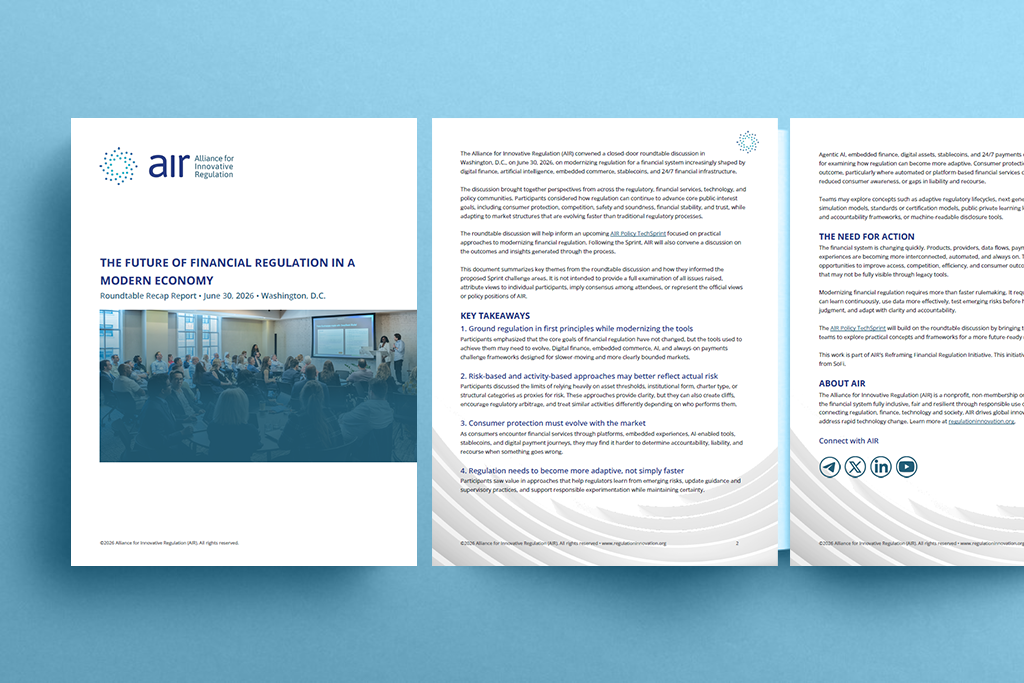
The initiative began with a June 30, 2026, closed-door roundtable in Washington, D.C., where senior leaders explored where existing regulatory approaches may no longer fully align with current market realities. Those insights informed the Policy TechSprint’s initial challenge areas.

The Policy TechSprint will help translate that discussion into practical concepts. Its outcomes will also inform a future public, senior-level roundtable on the broader vision for a more future-ready regulatory system.

Supported By

Supported by SoFi

Led by the Alliance for Innovative Regulation (AIR), with support from SoFi.

FAQs

No. Participation in the Policy TechSprint is free for all selected participants.

Participants are responsible for arranging and covering their own travel, accommodations and related expenses.

No. The Policy TechSprint needs people with a range of expertise. Not every participant will be expected to build a technical prototype.

Yes. Organizations may nominate representatives to apply. Selection will depend on the relevance of each nominee’s experience and the overall balance needed across teams.

Yes. Multiple people from the same organization may apply. Selection will depend on the overall participant and team mix.

Core participants must attend the virtual orientation and bootcamp and participate fully throughout the two day, in-person Policy TechSprint.

Yes. People interested in attending Demo Day in-person may register separately. AIR will confirm attendance in advance, subject to available space.

The solutions will inform the next phase of the Reframing Financial Regulation initiative. AIR may also consider selected concepts for further research, testing, development or collaboration.

WHITE PAPER • Beyond Pilots and Sandboxes: Regulatory Innovation through SupTech Case Studies and Leading Practices

This paper explores how regulators can use Supervisory Technology (SupTech) to enhance financial oversight. It outlines best practices for implementation, key capabilities to consider, and provides case studies showcasing SupTech’s benefits in modernizing regulation.

OFFERING • AIR’s Innovation Elements Framework

AIR’s proprietary human-centered framework helps financial regulators demystify and navigate complexity, adapt responsibly, and build confidence for sustainable change. This isn’t theory. It’s a tool for action.
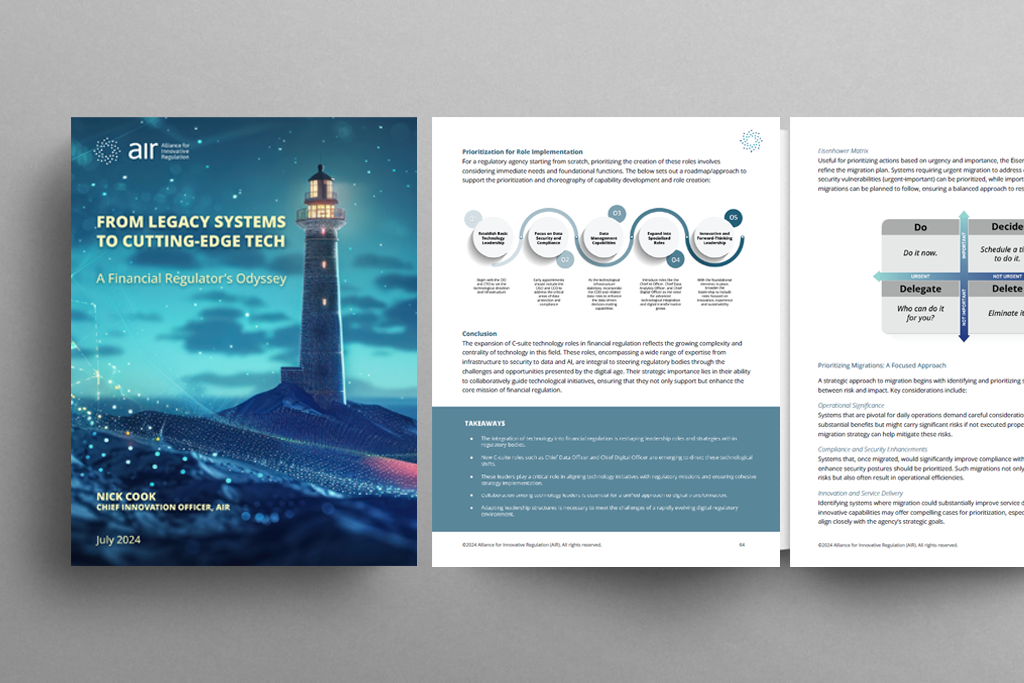
Cover image of AIR's white paper "From Legacy Systems To Cutting-Edge Tech: A Financial Regulator’s Odyssey" displaying a lighthouse in tumultuous waters.

WHITE PAPER • From Legacy Systems To Cutting-Edge Tech: A Financial Regulator’s Odyssey

Written by AIR CIO Nick Cook, this paper aims to offer strategic guidance, technology insights, and advocate for cultural and organizational adaptation within financial regulatory bodies to embrace digital transformation.

Get involved

Stay informed by joining our mailing list