Central banks and financial regulators face sustained and complex pressure.
They must respond to rapid change across financial markets and technologies while continuing to deliver confidence, stability, proportionality, and predictability in their supervisory and regulatory functions.
This challenge is not reducible to any single intervention.
Adaptive performance depends on how governance, people, operating models, data, incentives, and culture interact in practice — not only on strategy or technical expertise in isolation.
In this context, innovation is best understood as an organizational capability.
It reflects an institution’s ability to:
Sense and interpret weak signals and emerging risks
Integrate insight across organizational boundaries and hierarchies
Make informed judgements within clearly articulated risk tolerances
Learn from experience, including from initiatives that do not proceed as planned
Adapt behaviors and decisions over time without undermining institutional legitimacy
These capabilities are widely recognized in principle, but far harder to observe, measure, and manage across an entire organization.
They manifest through everyday behaviours, decision-making norms, informal incentives, and micro-practices that cut across formal structures and systems.
As a result, many regulators possess strong individual components of a modern regulatory organization — capable staff, articulated strategies, digital initiatives — without a shared view of how these elements combine to enable adaptive performance across the institution as a whole.
The core question becomes:
How can regulators systematically understand and prioritize the capabilities that underpin effective and adaptive regulatory organizations — without oversimplifying complexity or underestimating operating reality?
The framework helps regulators answer three practical questions:
Where are we today?
Mapping organizational capability across eight dimensions.
What is helping or hindering progress?
Identifying behavioral, structural, and cultural enablers and blockers.
What should we prioritize next?
Defining proportionate and realistic pathways for improvement.
The IEF examines how multiple organizational dimensions and elements interact to enable — or constrain — adaptive performance.
It is structured across eight interdependent dimensions.
Leadership, Governance & Decision Agility
How authority, accountability, and risk tolerance shape institutional judgement and decision making.
Enabling Environment & System Conditions
The institutional and systemic conditions that define what innovation is feasible.
Ecosystem Engagement & Market Shaping
How the regulator interacts with and shapes the broader financial ecosystem.
People, Talent & Capability Development
How skills, confidence, and professional capability are developed and sustained across the organization.
Culture, Values & Narrative
The informal norms, incentives, and shared narratives that shape behavior, confidence, and judgement across the organization.
Innovation Methods, Tools, Infrastructure
The structured practices and systems that support experimentation and collaboration.
Strategic Intent & Institutional Positioning
How innovation is embedded within mandate, strategy, and institutional role.
Learning, Feedback & Adaptation
How experience is translated into institutional learning and behavioral adjustment.
Each dimension is further articulated through 80+ elements and 300+ defined states, enabling institutions to examine capability in detail and identify priorities for development
AIR supports central banks, supervisors, and development partners to strengthen practical organizational capability for innovation — how institutions identify problems, make decisions, and act under real constraints.
At the center of this work is our proprietary Innovation Elements Framework (IEF).
The IEF provides a way to make organizational capability visible.
Our framework distills real-world regulatory practice into a structure that is practical and accessible. It is grounded in lived experience and informed by evidence and stories from regulators working within real institutional constraints.
Rather than prescribing a one-size-fits-all solution, it provides a shared language for examining organizational capability.
It is designed to be applied through reflection, dialogue, co-creation, and practical testing of ideas, so that innovation capability becomes embedded in everyday work.
It enables regulators to:
• Map innovation capability across the institution
• Identify behavioral and cultural enablers and blockers
• Clarify how organizational factors interact
• Determine proportionate and realistic pathways for progress
The framework is not a checklist or prescriptive maturity model. It provides a structured basis for joint inquiry, enabling institutions to examine how organizational conditions interact and determine appropriate next steps.
Institutions using the Innovation Elements Framework typically experience several practical benefits:


Deep, targeted advisory support grounded in the Innovation Elements Framework. We combine capability-building, culture work, strategic alignment and senior-level advisory to strengthen innovation leadership and institutional readiness.
Immersive, multi-day learning environments that allow regulators to step away from operational pressures to build innovation capability through experiential learning, sense-making, and human-centered tools. Cohorts can span teams, institutions, or jurisdictions.
High-impact sessions on topics including adaptive culture, design thinking, data, AI, and innovation scaling that help regulators navigate complex policy and supervisory environments, blending behavioral science with practical tools and structured dialogue.
Active, design-led working sessions that bring regulators, industry participants, and ecosystem actors together to generate insight, build shared understanding, explore complex systems, and co-develop concepts, tools, systems or policy pathways.

EVENT • Innovation Elements: Cohort for Financial Regulators
Innovation Elements Cohort was a 4-day immersive experience in London in the autumn of 2025 designed for regulators to accelerate their organization’s innovation capacity. The program included expert-led sessions, hands-on workshops, and collaborative problem-solving.
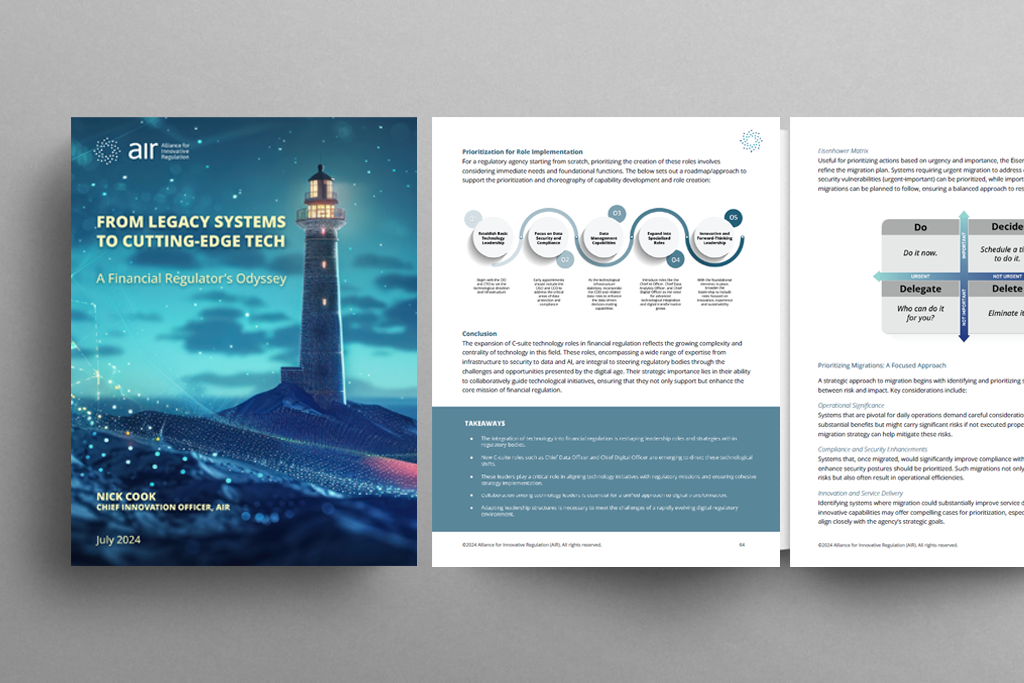
WHITE PAPER • From Legacy Systems To Cutting-Edge Tech: A Financial Regulator’s Odyssey
Written by AIR CIO Nick Cook, this paper aims to offer strategic guidance, technology insights, and advocate for cultural and organizational adaptation within financial regulatory bodies to embrace digital transformation.

PODCAST • The Financial Regulators’ Odyssey: AIR’s Innovation Lead Nick Cook
AIR’s Nick Cook discusses the “Financial Regulators’ Odyssey” — the journey that lies ahead for virtually every financial regulatory body in the world, in catching up their own technology and cultures to the age of digitized data and AI.
Stay informed by joining our mailing list