December 16, 2025
Money has evolved over thousands of years, with its development punctuated by breakthrough innovation — from shells and stones, through metal and then paper currency, and on to our modern age of moving value via electrons. It seems possible that we are now witnessing the start of a new era. Stablecoins are coming into their own in terms of legal frameworks and nascent trust, and are bringing with them the potential to create a new and better infrastructure layer for payments by leveraging some combination of superior attributes in programmability, composability, transparency, interoperability, speed and cost. Public and private sector leaders throughout the world are busy exploring what these attributes could enable, both good and bad.
Nowhere is this exploration more intense than in Africa, and for today’s show, I’m thrilled to share a special episode we recorded on the sidelines of AIR’s recent London roundtable on stablecoins on the African continent. Sitting across from me were Efayomi Carr of Flourish Ventures and Elise Soucie Watts of Global Digital Finance — two voices deeply active in Africa’s fintech evolution. We talked about the economic outlook for the continent and why stablecoins are rising, from Lagos to Nairobi. In markets where currencies depreciate and fluctuate, and where banking access is limited, people are turning to digital dollars and even commodity‑backed tokens for cross‑border payments, savings and trade.
In our conversation, Efayomi walks us through the journey from mobile money to blockchain: he made his first blockchain investment in Kenya back in 2021, when “crypto” was still, to many people, a dirty word. Today, stablecoins account for about 43% of crypto transaction volume in sub‑Saharan Africa, and venture capitalists like Efa see valuable use cases. He explains how businesses now pay suppliers overseas without waiting days or paying hefty foreign‑exchange fees, and how individuals hedge against volatile national currencies by parking value in stablecoins. The high cost of remittances (sending $200 into sub‑Saharan Africa can cost around 7–9% in fees) makes these digital alternatives even more compelling.
Elise brings a global regulatory lens. She’s worked at the U.K. Financial Conduct Authority and now leads the GDF, which is an industry association working with stablecoin issuers, banks and policymakers. In our conversation, she notes that stablecoin adoption in Africa is different. Since most stablecoins are backed by U.S. dollars, regulators worry about the dollarization of their economies. As a result, there’s talk of backing coins with commodities — gold‑, cocoa‑ or diamond‑backed coins. Elise also stressed that innovation has outpaced regulation; the Financial Stability Board warns that gaps and inconsistencies in global stablecoin rules could pose financial‑stability risks. For stablecoins to deliver on their promise — cheaper payments, financial inclusion and economic growth — regulators need to provide clear rules, ensure full reserve backing and build trust with young, tech‑savvy users.
Our conversation was lively, and also personal. Efayomi shares how a government ban in Nigeria actually fuelled adoption — in fact, he says that during the #EndSARS protests, crypto actually became a rebellion tool, because it operated outside the formal banking system. Our conversation covers how a lack of trust in monetary policy pushes people towards alternative rails, and how regulators must engage entrepreneurs to craft rules that work in the real world. Elise highlights public‑private dialogue and consistent vision from governments as critical to building credible frameworks.
You’ll hear us wrestle with big questions: Can stablecoins help Africa leapfrog outdated payment rails and foster financial inclusion? What happens to monetary sovereignty when private coins become everyday money? And how can regulators shape an ecosystem that supports innovation while protecting consumers?
AIR is currently doing two projects in Africa, and also two streams of work on stablecoins. Today’s show reflects both. Join us to explore how Africa’s fintech frontier is reimagining money — and what the rest of the world can learn from it.
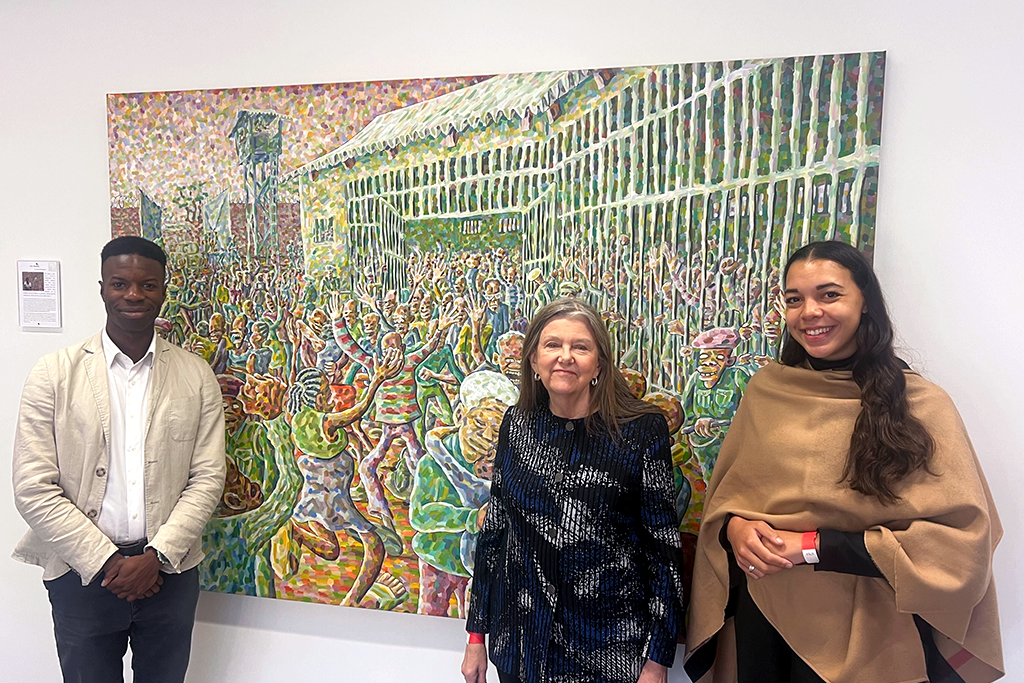
🎨 Painting Credit: Kambudzi, Lovemore. Free Mandela. Crown Agents Bank, London.
Efayomi is an investor at Flourish Ventures, based on having seen firsthand how startups catalyze innovation and unleash opportunity for communities. He brings experience in entrepreneurship, social impact and finance to his role at Flourish, with a focus on Africa.
Previously, Efayomi was Head of Strategic Finance for Lori, a tech startup building cost-saving market infrastructure for the trucking industry in Africa. He oversaw core financial functions, managed a team of finance professionals across several geographies and guided the company financially through the COVID-19 economic crisis, raising emergency capital, renegotiating debt, and finalizing key partnership agreements.
Prior to working with Lori, Efayomi covered Africa with venture investor Quona Capital and was an associate at Boston Consulting Group. He also worked at Jumia, where he was Head of Marketplace, growing that business from launch to roughly one-quarter of the platform’s revenue. He was also seconded to the government of Sierra Leone, as the most senior government official leading data management in the effort to combat the 2015 Ebola outbreak.
Efayomi started his career cofounding Transparent Nigeria, a digital journalism and data sharing platform. He is a graduate of the University of Pennsylvania with an MBA from Harvard Business School. He is based in Nairobi, where he’s training for his next marathon.
Elise is the Executive Director of Global Digital Finance (GDF), as well as a board member and board advisor to several firms on policy and regulatory issues. She is also the co-host of the podcast The Outside Context.
Previously, she was at the Association for Financial Markets in Europe (AFME), leading Digital Assets and Data Strategy work, and prior to that she worked at the U.K. Financial Conduct Authority (FCA) across both their Technology, Resilience and Cyber Division. and International Division.
Elise was named ‘Next Generation Leader of the Year’ at the 2022 Women in Finance Awards UK, and part of the Innovate Finance Standout 45 on the Women in Fintech Powerlist 2024 as a Regulatory and Policy Expert. Her dual public and private sector experience positions her to lead both regulatory advocacy and contribute technical knowledge to support the growth of the digital assets ecosystem.
Still to come on Barefoot Innovation, I sit down with Patrick Murck, CEO and Co‑Founder of Surus, for a candid look at innovating financial infrastructure. Then Saket Narayan of AWS joins me to explore how cloud and AI technologies are reshaping compliance. And we’ll have part 2 of our very popular conversation on financial crime with gurus Carole House, Ari Redbord, and Matthew Van Buskirk, diving even deeper into how we can fight fraud and protect consumers.
AIR Events
AIR Speaking Engagements
Here’s a full list of speaking engagements and events.
Thank you for listening! If you enjoyed this episode, please rate us on your favorite podcast platform and share it with colleagues.
Stay informed by joining our mailing list