As digital financial innovation rapidly advances, AIR is leading a multi-phase regulatory engagement program, Stablecoins and the African Financial System. It’s designed to help countries advance stablecoin readiness while prioritizing financial stability and consumer protection. The program uses global regulatory insights, translating them into deep regional and national engagements that address country-level context.
The significance of this work is growing quickly across Africa. Stablecoins now account for 43% of all crypto transactions on the continent1, signaling that digital assets are moving beyond speculative activity and becoming part of the continent’s financial plumbing. From helping households and businesses manage currency volatility to enabling faster, cheaper cross-border transfers, stablecoins are emerging as a practical tool for economic participation and financial resilience.
Throughout November, AIR’s team engaged deeply across the continent and globally. We convened stakeholders, shared research, and supported policy development as momentum builds around stablecoin regulatory readiness. Our initial engagements spanned four major forums: Africa Stablecoin Summit, Global Stablecoins Dialogue Workshop, Africa FinTech Festival and a virtual forum on stablecoins hosted by the SME Finance Forum and International Finance Corporation (IFC).


At the Africa Stablecoin Summit, AIR hosted a roundtable on Forging a Pan-African Regulatory Framework for Stablecoins. Bringing together senior leaders from across the continent, the conversation explored:
This dialogue underscored a shared recognition: stablecoins are already shaping financial behavior in Africa, but coherent regulatory guardrails are critical to ensure these innovations support, not destabilize, local economies.

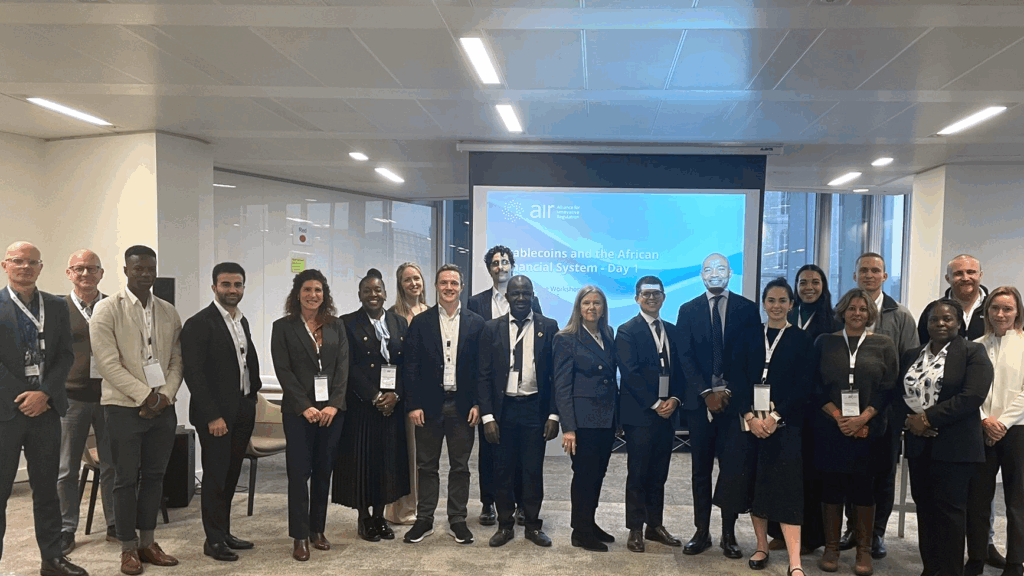
The AIR team hosted a Global Stablecoins Dialogue Workshop in partnership with Global Digital Finance. The workshop convened a broad ecosystem, including a range of global and African regulators, industry players, and experts, to explore emerging regulatory developments and compare international approaches.
We then built on these global perspectives by turning to Africa-specific considerations, examining how global lessons translate into practical regulatory pathways at regional and national levels. The workshop focused on a key set of principles developed by Global Digital Finance, offering a functional baseline outlining the risks, safeguards, and outcomes a stablecoin regulatory regime should address across jurisdictions. These principles created a shared language for the ecosystem, cutting through the complex jargon and differing interpretations that often separate regulators, issuers, exchanges, and industry players, and enabling more productive dialogue and debate.
Key discussion themes included:
Redemption
What principles should guide timely and reliable redemption of stablecoins in markets where currency volatility, fragmented payment systems and cross-border remittance flows heighten the importance of convertibility?
High-Quality Liquid Assets (HQLA) equivalence
What can be considered as HQLA for reserve backing in African markets, and how could equivalence work at a regional or Pan-African scale?
Dollarization & sovereignty
In markets where exchange rate instability, limited access to foreign currency, and high reliance on remittances already put pressure on monetary autonomy, should regulators consider caps on USD-denominated stablecoin volumes relative to domestic currency transactions to help preserve monetary sovereignty?
Participants also explored the value of regulatory sandboxes in testing and refining Virtual Asset Service Provider (VASP) regulations. The Bank of Ghana shared insights from its current sandbox cohort on VASP business models, highlighting how iterative testing with ecosystem partners strengthens regulatory design. Education emerged as another key pillar, with Ghana’s nationwide public awareness campaign highlighted as a leading example of collaborative capacity building.
Listen to the podcast recorded on the sidelines of this event:
We concluded a busy November by participating in the Africa FinTech Festival in Pretoria and joining a stablecoins virtual forum hosted by the SME Finance Forum and IFC. Across these engagements, one message resonated: Stablecoin policy is the very definition of a “wicked problem” — multi-stakeholder, technically complex and evolving rapidly. No single institution can solve it alone.
Because our approach is neutral, practical, and politically sensitive, AIR is uniquely positioned to bring regulators, innovators, and industry actors together to navigate these shared challenges and design coherent, forward-looking frameworks.
Having completed the global and regional insight-gathering phase, AIR is now moving into the Regional and National phases of the project. Over the coming months, we will host a series of in-depth policy workshops to support:
• Context-specific regulatory analysis
• Comparative evaluations of global approaches
• Structured pathways for harmonizing national, regional, and continental policy positions
These engagements will directly inform a Global Regulatory Playbook which will be published early 2026 in partnership with Global Digital Finance, followed by a dedicated Africa chapter led by AIR and anticipated for publication April 2026.
Stablecoins present both opportunity and regulatory complexity for African financial systems. Our multi-phase program is helping countries engage with these questions proactively, collaboratively, and with evidence-based insight drawn from global best practices. As Africa continues to shape the global stablecoin conversation, AIR remains committed to enabling regulators and innovators to chart a path that advances financial inclusion, protects consumers and supports resilient digital financial ecosystems.If you are interested in finding out more about this project and our upcoming program of work relating to stablecoin regulations, please reach out to AIR’s Innovation Programs Lead Lauren Cassells.
Stay informed by joining our mailing list