As digital financial services expand, regulators need better ways to understand who is being served and who is not. This AIR program aims to support existing regulators’ gender-disaggregated initiatives to build more inclusive, responsive financial systems.
Digital financial services offer new opportunities for inclusion, but persistent gender gaps remain. Women continue to face barriers in access, usage, credit, and product relevance across many markets.
Traditional regulatory tools alone are no longer enough. To respond effectively, regulators need timely, usable data that reveals where exclusion occurs and whether interventions are working. Gender-disaggregated data makes these gaps visible and supports smarter, more equitable decision-making.
AIR’s Gender-Disaggregated Data for Inclusive Regulation Program supports financial sector regulators to strengthen how gender-disaggregated data is collected, analyzed, and applied in supervision and policymaking. By positioning data as both a diagnostic and an accountability tool, the program supports more adaptive, inclusive regulation.
The program combines research, collaboration and design sprints to:

Map current gender-disaggregated data practices and gaps

Engage regulators and ecosystem experts

Co-design practical tools, dashboards, and use cases

Advance solutions toward real-world implementation and potential digital public goods
The program combines in-country engagement with continuous collaboration across the global regulatory ecosystem. AIR is working deeply with regulatory ecosystems in:

Bangladesh

Nigeria

Pakistan

Tanzania
AIR is also engaging regulators and stakeholders globally throughout the process to share insights, exchange best practices, and support collective learning.
Across the focus countries, AIR is mapping how gender-disaggregated data is currently used and identifying opportunities to strengthen inclusive supervision and policy — insights that are then fed back into the wider global dialogue.
Inclusive regulation cannot be built in isolation. This program brings together regulators, supervisors, technology and data partners, financial service providers, researchers, international organizations, and more.
By working collaboratively, partners gain early insight into emerging tools and contribute to solutions that can be adapted and scaled across markets — strengthening gender-disaggregated data ecosystems, peer learning and advancing women’s economic empowerment.
To explore partnership opportunities or learn more about the program, please contact Victoria Jory.
The Global Advisory Group is a voluntary membership and will run for the duration of the project only. The group will share expertise and knowledge focused on GDD and surrounding information. The group will help to build statements for the sprints, support amplification and advocacy, and assist where relevant in recruitment for the sprints and supporting in ensuring the correct ecosystems are invited to the table.


EVENT • From Ideas to Implementation: Connecting Gender Data Solutions Across Markets
Join AIR on October 27 to explore innovative gender data solutions, lessons from Design Sprints in Tanzania, Nigeria and globally, and opportunities to turn promising ideas into action. Plus, discover AIR’s new Gender Data Playbook.
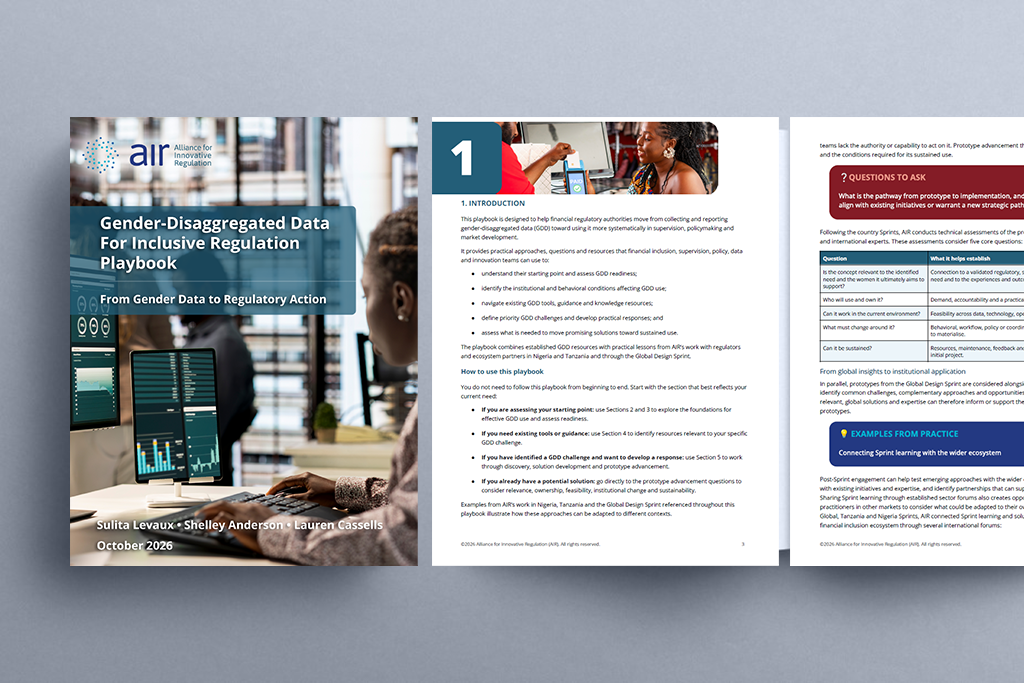
WHITE PAPER • Gender-Disaggregated Data for Inclusive Regulation Playbook
AIR’s Gender-Disaggregated Data Playbook offers financial regulators practical guidance, tools and strategies to move beyond data collection and turn gender data into regulatory action that advances people’s financial health and inclusion.

BLOG • Building the Foundations for Gender-Responsive Regulatory Data Reform
Collecting gender data is only the first step. Explore how AIR helps financial regulators identify institutional barriers, strengthen organizational capabilities and turn gender-disaggregated data into meaningful regulatory action.

REPORT • AIR’s Nigeria Design Sprint Recap Report
AIR and the Central Bank of Nigeria brought together 65 participants to develop 10 innovative solutions that turn gender data into action. Explore the winning prototypes and lessons for advancing women’s financial inclusion.
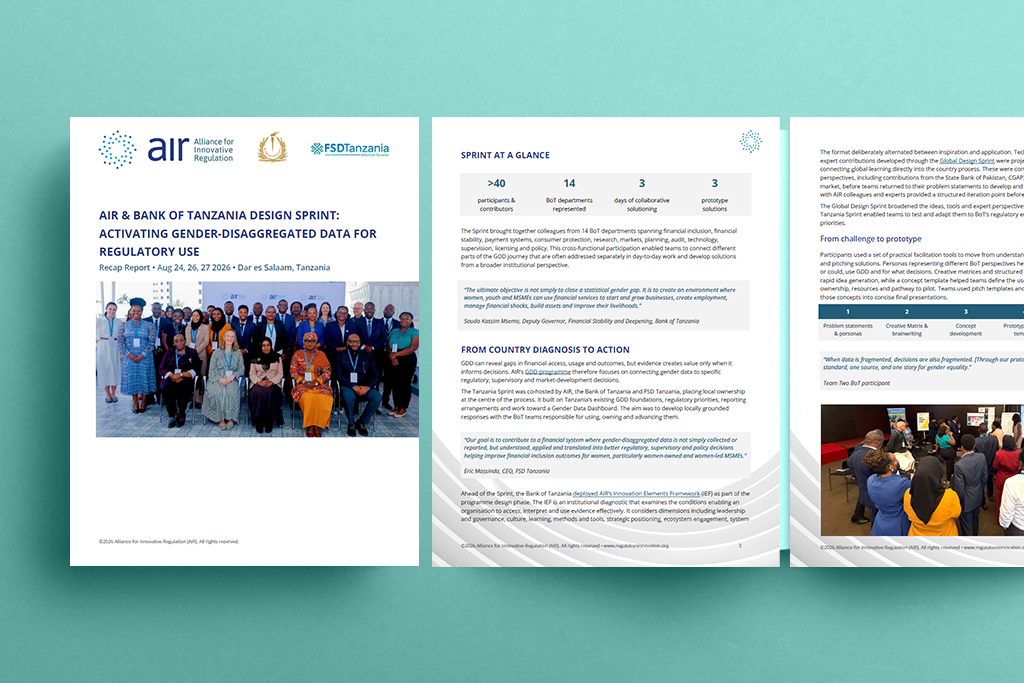
REPORT • AIR’s Tanzania Design Sprint Recap Report
Explore how AIR, the Bank of Tanzania and FSD Tanzania collaborated to develop three prototype solutions that connect gender-disaggregated data to better regulatory decisions. Read the recap for key outcomes and lessons.
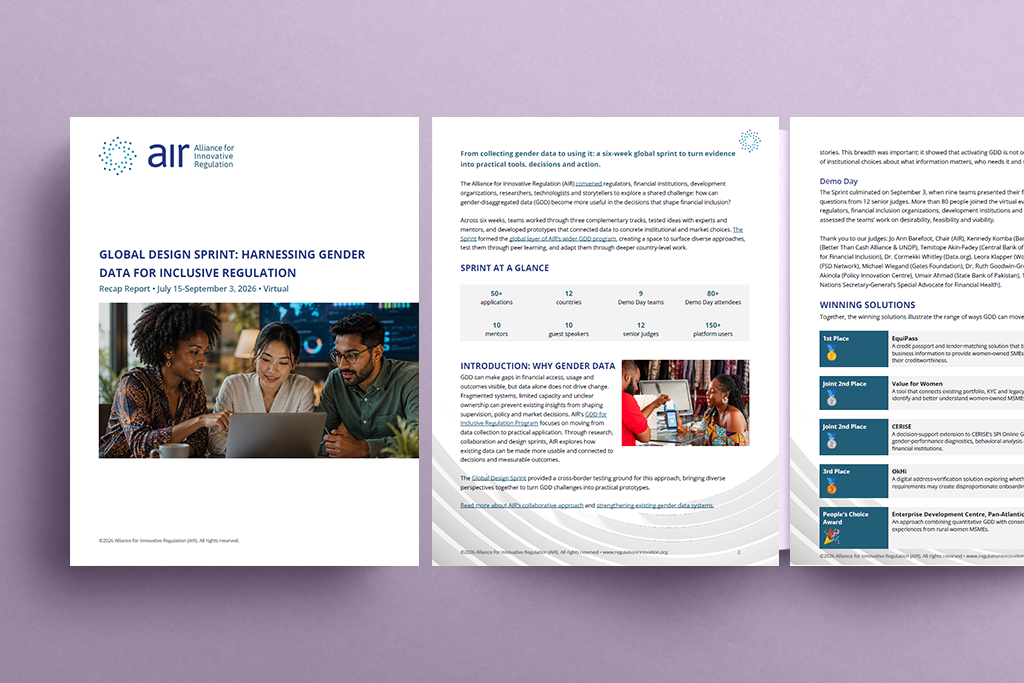
REPORT • AIR’s Global Design Sprint Recap Report
Discover how nine global teams virtually developed innovative solutions to turn gender-disaggregated data into actionable insights. AIR’s recap highlights winning prototypes and key lessons for advancing women’s financial inclusion.

DESIGN SPRINT • Activating Gender-Disaggregated Data for Impact
AIR and the Central Bank of Nigeria hosted a three-day Design Sprint in Lagos to turn gender-disaggregated data into practical tools, policies and solutions that advance women’s financial inclusion.

DESIGN SPRINT • Harnessing Gender Data for Inclusive Regulation
AIR’s virtual Global Design Sprint, July 20–Sept. 3, 2026, brought global experts together to turn gender-disaggregated data into practical tools, insights and action for inclusive financial regulation.
BLOG • Going Further, Together: Collaborating to Strengthen Gender-Disaggregated Data
This blog outlines collaborative work, challenges in data use, and the multi-country effort to better collect, analyze, and apply GDD for meaningful policy impact.

PODCAST • Seeing the Gaps: Gender Data and the Future of Inclusive Finance
Wendy Teleki and Tatiana Alonso join Jo Ann to explore why gender-disaggregated data is essential to inclusive finance, smarter supervision, and unlocking capital for women entrepreneurs worldwide.

BLOG • Strengthening Existing Gender Data Systems for Financial Inclusion
How can regulators turn gender-disaggregated data into better financial inclusion outcomes? This blog explores practical examples from Nigeria, Tanzania, Bangladesh, Pakistan, and Rwanda — and highlights tools that can help strengthen GDD systems worldwide.
Stay informed by joining our mailing list