Ready to improve financial health in the UAE?

Led by the Central Bank of the UAE (CBUAE) and delivered by the Alliance for Innovative Regulation (AIR), the Financial Health Innovation Challenge seeks market-ready solutions that can measurably improve financial health for individuals and micro, small and medium-sized enterprises (MSMEs) in the UAE.

Selected applicants will have opportunities to work with participating UAE-licensed financial institutions to adapt, test and demonstrate solutions in the UAE. These institutions offer banking, savings, remittance and investment products and services, and may serve as pilot hosts and/or provide targeted expertise and other support to applicants and the Challenge.

Solutions will focus on four dimensions of financial health: helping individuals and MSMEs manage day-to-day finances, absorb financial shocks, pursue longer-term goals and make financial decisions with confidence. The Challenge is looking for innovation in its broadest sense, including new or improved financial products, services and technologies, as well as new delivery models and approaches for reaching and serving communities.

The Financial Health Innovation Challenge is rooted in the UAE National Financial Inclusion Strategy 2026-2030 and the UAE National Financial Literacy Strategy 2027-2031, which set the national direction for advancing inclusive finance and strengthening financial capability.

Objectives

The Financial Health Innovation Challenge puts that commitment into action by creating a practical route for financial institutions and innovators to test market-ready solutions and generate evidence about what can improve financial health for individuals and MSMEs in the UAE.

The CBUAE Financial Health Innovation Challenge aims to:

  • Identify market-ready solutions with the potential to deliver clear, measurable improvements in financial health for individuals and MSMEs in the UAE.
  • Focus innovation on practical financial health needs: helping individuals and businesses manage day-to-day finances, absorb financial shocks, pursue longer-term goals and make financial decisions with confidence.
  • Connect promising innovators with participating UAE-licensed financial institutions to explore, design and implement viable pilots.
  • Support responsible innovation that considers consumer protection, accessibility, inclusion, data protection and information security from the outset.
  • Generate evidence and learning that can support the continued development and scaling of effective financial health solutions in the UAE.
  • Advance priorities of the UAE National Financial Inclusion Strategy 2026–2030 and the National Financial Literacy Strategy 2027-2031.

Challenge Areas

The four Challenge areas reflect priorities identified through the UAE National Financial Inclusion Strategy and related CBUAE research.

“Everyday” money

Access and usage remain uneven, particularly among lower-income earners. Remittances, limited wallet use, debt repayments and cash-flow pressures shape the financial lives of many households and businesses.

How might we help individuals and MSMEs receive, hold, spend and send money reliably and affordably, manage cash flow and meet current obligations without undue stress?

This could include accessible accounts, useful wallet services, affordable remittances, budgeting and cash-flow tools, responsible small-ticket credit, debt support, and affordable payment acceptance for MSMEs.

“Rainy day” money

A significant unexpected expense or loss of income would leave many people financially exposed. Irregular earnings and disruptions to business revenue can create similar pressures for individuals and MSMEs.

How might we help individuals and MSMEs prepare for and withstand financial shocks without harmful borrowing or lasting financial damage?

This could include emergency and payroll-linked savings, income smoothing, accessible financial buffers, and insurance protecting income, assets and property.

“One day” money

Saving for retirement, education and other longer-term goals remains limited. Younger adults face particular barriers, while MSMEs need appropriate finance and planning tools to invest and grow.

How might we help individuals and MSMEs set financial goals, commit resources and make measurable progress towards them?

This could include goal-based saving, youth accounts, retirement planning, longer-term investment, MSME growth and working capital, education and family milestones, and cross-border financial planning.

Across all three areas

People do not always have the information, confidence or support needed to navigate important financial decisions. Uncertainty about fraud reporting, redress and where to seek help can make this harder.

How might we help individuals and MSMEs understand their options, act confidently and know where to turn when something goes wrong?

This could include guidance at key decision points, plain-language disclosures and Key Facts Statements, debt counselling, fraud prevention and response, and access to consumer recourse.

Applicants must select the one challenge area that best represents the primary outcome their solution will deliver and measure through the pilot.

A solution may contribute to more than one area, but applicants should choose the area in which they expect to demonstrate the clearest impact.

Priority Segments

The Challenge welcomes solutions that can improve financial health for individuals and businesses across the UAE. Within this broad ambition, it is particularly interested in solutions that address the financial needs of priority population and business segments and improve their financial health outcomes.

• Emirati families
• Low-income earners
• Older individuals and pensioners
• Micro, small and medium-sized enterprises

• Young individuals and children
• People of Determination
• Investors
• Women

These segments apply across all four challenge areas and may overlap. Applicants are not expected to serve every segment. They should identify the primary segment their solution is designed to serve and may identify additional segments where relevant.

Why Apply

The Challenge offers selected applicants a structured opportunity to strengthen, test and demonstrate market-ready solutions in the UAE.

  • Strengthen your UAE proposition: gain insight into local needs, institutional priorities and deployment requirements.
  • Explore partnerships and potential pilots: engage with participating UAE-licensed financial institutions and, where there is a suitable match, develop a focused pilot.
  • Access tailored support and funding: receive readiness, mentoring and pilot-design support, with grants available to eligible selected applicants.
  • Build evidence for growth: demonstrate financial health impact and operational feasibility to support wider adoption or scale.
  • Contribute to a national priority: help advance the UAE’s financial health ambitions.

The opportunities available will depend on the stage reached.

Access grant support: Up to seven shortlisted applicants will each receive an AED 30,000 participation grant to contribute towards the time and costs of taking part in the Challenge, including any required travel. Applicants progressing to the pilot stage may receive up to an additional AED 90,000 to support pilot design and implementation. All grants are subject to the applicable funding, selection, approval, due-diligence and grant-agreement requirements. Challenge grants are made possible by the support of the Mastercard Center for Inclusive Growth.

Who Can Apply

The Challenge is open to organisations with market-ready solutions that can be deployed and tested with a participating UAE-licensed financial institution.

A market-ready solution should already be working, have been tested or used in a real-world setting, and be capable of being adapted for a controlled pilot in the UAE within the Challenge timeframe.

Applicants must:

  • Submit their application in the English language.
  • Address one of the four financial health challenge areas.
  • Have a working solution beyond the idea or early prototype stage.
  • Demonstrate credible ability to deploy and test the solution in the UAE.
  • Be willing and able to work with a participating UAE-licensed financial institution within its applicable license, controls and consumer-protection framework.
  • Meet applicable data-protection, data-residency, information-security, procurement and due-diligence requirements.
  • Commit sufficient team capacity to participate throughout the Challenge.

Meeting the eligibility criteria does not guarantee selection.

How Applications Will Be Evaluated

Evaluation will take place in stages and may include application review, clarification discussions, clinics, matching and further due diligence. Applicants will only be asked for information necessary and proportionate to each stage.

Progression does not guarantee a pilot. This will depend on a suitable institutional match, agreement on a viable pilot and completion of the relevant approvals and due diligence.

Applications that meet the eligibility criteria will be assessed against the following areas:

  • Financial health impact: The significance of the financial need addressed and the potential to deliver a clear, measurable improvement for people or MSMEs in the UAE.
  • Challenge and user alignment: The strength of the solution’s alignment with one challenge area and its relevance to the intended users, including priority segments where applicable.
  • Market readiness: Evidence that the solution is sufficiently developed, tested and ready for a controlled pilot
  • UAE feasibility and responsible delivery: The ability to deploy the solution within the UAE regulatory environment, with appropriate provision for consumer protection, accessibility, inclusion, data protection and information security
  • Institutional fit and delivery capacity: The potential to work effectively with a participating licensed financial institution and the team’s capacity to design and deliver a pilot
  • Potential to scale: A credible pathway for the solution to continue, expand or be replicated beyond a single pilot

Challenge Timeline*

*Dates are subject to change.

Apply for the CBUAE Financial Health Innovation Challenge

Have a market-ready solution that could improve financial health for individuals or MSMEs in the UAE? Explore the Challenge areas and eligibility requirements, then submit your application.

Applications close 30 November 2026 at 23:30 GST.

Challenge Terms and Conditions and Privacy Notice

Have questions? Contact us via email.

Delivery Partner

Ecosystem Partner

Collaboration Partner

Supporters

FAQs

No. The Challenge takes a broad view of innovation. Solutions may include new or improved products, services and technologies, as well as delivery models and approaches for reaching and supporting communities.

The solution must be market-ready. It must be working, have progressed beyond the idea or early prototype stage, and have evidence of testing, deployment or use in a relevant real-world setting.

Evidence may come from end users, business clients, institutional partners, commercial pilots, regulatory sandboxes or other relevant deployments.

Yes. UAE-licensed financial institutions and other regulated firms may apply if their solution meets the eligibility criteria.

An institution may participate either as an applicant or as a potential pilot partner, but not both during the same Challenge cycle.

Yes. Organisations based outside the UAE may apply if they can demonstrate a credible ability and commitment to deploy and test their solution in the UAE.

Applicants must be able to meet applicable legal, regulatory, operational, data-protection and information-security requirements. Whether a local entity is required will depend on the solution and proposed pilot arrangements.

No. Applicants do not need an existing institutional partner when they apply.

Shortlisted applicants will have opportunities to engage with participating UAE-licensed financial institutions and explore potential partnerships to support pilot delivery and future scale.

Applicants reaching the matching and pilot-design stages should expect to participate in person in the UAE. Readiness Clinics may be held virtually where long-distance travel makes attendance impractical. Applicants will receive advance notice of relevant dates and expectations.

The participation grant may be used towards reasonable participation costs, including required travel. Limited additional travel support may also be considered case by case, but is not guaranteed to cover all travel or accommodation costs.

Subject to the applicable conditions, up to seven shortlisted applicants will each receive an AED 30,000 participation grant.

Applicants that are successfully matched with a participating UAE-licensed financial institution and approved to develop a pilot may receive up to an additional AED 90,000 to support pilot design and implementation. This funding will be released in installments linked to agreed milestones.

All grants are subject to confirmation of funding, selection and approval, satisfactory due diligence and signature of a grant agreement. They are intended to contribute towards costs and may not cover the full cost of participation or pilot delivery.

The names and approved logos of shortlisted organisations and those selected for pilots will be announced through the Challenge’s public communications. Organisations will be informed before any announcement is made.

Applicants that do not reach the shortlist will not be named publicly.

No. The Challenge is not a regulatory sandbox and does not provide exemptions from applicable laws, regulations, licensing conditions or institutional requirements.

Any pilot must operate within the existing regulatory and licensing perimeter. Where questions of regulatory interpretation arise, the Challenge can help the relevant parties identify and engage the appropriate CBUAE teams.

No. Participation does not guarantee a pilot, procurement, investment, commercial contract or continued use of a solution after the Challenge.

Any commercial arrangement between an applicant and a participating financial institution would be subject to a separate decision and agreement between those parties.

Application information will be handled in accordance with the applicant terms and privacy notice. Where necessary, it may be shared with CBUAE, AIR and relevant assessors, experts or potential pilot partners to evaluate the application, support matching or develop a potential pilot.

Applicants should not submit information they are not authorised to share.

Applicants retain any intellectual property rights they hold in the materials submitted. Rights relating to intellectual property developed through a pilot will be addressed separately in the relevant pilot agreements.

Additional Support

If you have additional questions about the Challenge, please reach out via email.

WHITE PAPER • Beyond Pilots and Sandboxes: Regulatory Innovation through SupTech Case Studies and Leading Practices

This paper explores how regulators can use Supervisory Technology (SupTech) to enhance financial oversight. It outlines best practices for implementation, key capabilities to consider, and provides case studies showcasing SupTech’s benefits in modernizing regulation.

OFFERING • AIR’s Innovation Elements Framework

AIR’s proprietary human-centered framework helps financial regulators demystify and navigate complexity, adapt responsibly, and build confidence for sustainable change. This isn’t theory. It’s a tool for action.
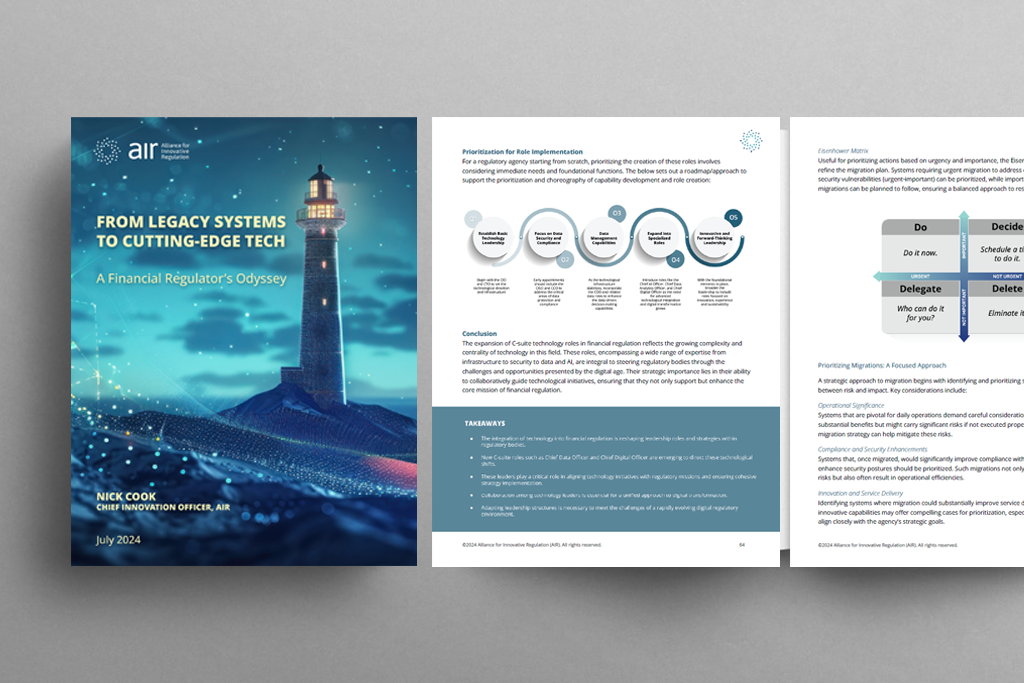
Cover image of AIR's white paper "From Legacy Systems To Cutting-Edge Tech: A Financial Regulator’s Odyssey" displaying a lighthouse in tumultuous waters.

WHITE PAPER • From Legacy Systems To Cutting-Edge Tech: A Financial Regulator’s Odyssey

Written by AIR CIO Nick Cook, this paper aims to offer strategic guidance, technology insights, and advocate for cultural and organizational adaptation within financial regulatory bodies to embrace digital transformation.

Get involved

Stay informed by joining our mailing list